
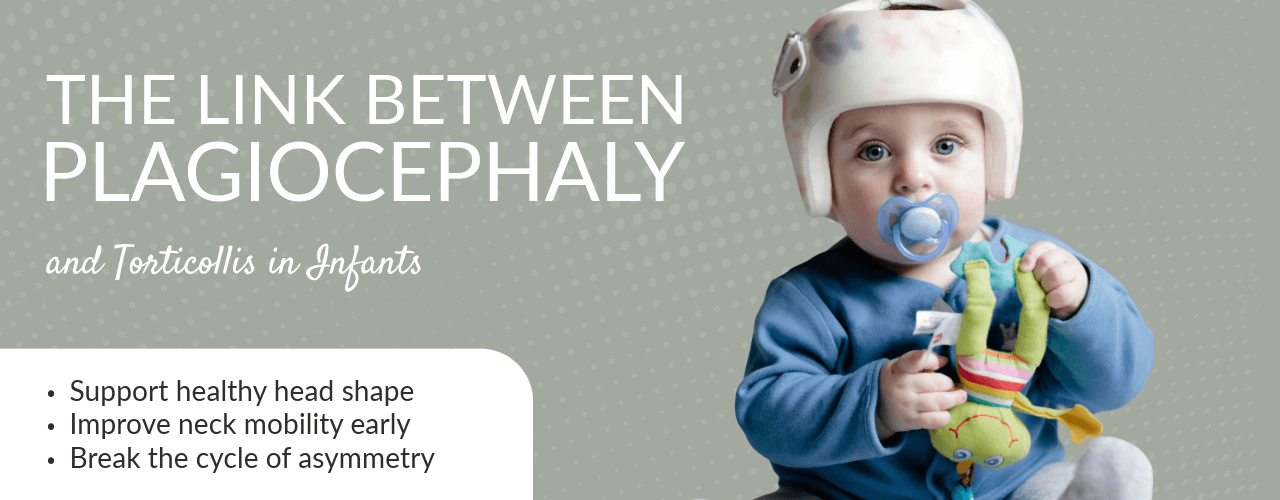
When new parents hear the terms plagiocephaly and torticollis, they’re often unfamiliar with what these conditions mean or how they might affect their baby. Yet, these two common pediatric concerns are closely connected and, if left unaddressed, could have long-term complications.
Fortunately, when addressed early, they can be effectively managed by the team at Therapy In Motion. Let’s dive into the link between plagiocephaly and torticollis and learn what you can do to ensure your baby’s healthy development.
Torticollis: What It Is and How It Shapes Your Baby’s Head
Torticollis is a condition where an infant’s neck muscles become tight or imbalanced, often causing the head to tilt to one side and rotate to the opposite side. This limited range of motion can stem from positioning in the womb, birth trauma, or early postnatal habits.
When a baby consistently favors turning their head in one direction, the pressure on one part of the skull increases. Since infant skulls are soft and still forming, this repeated pressure can lead to a flattening on one side of the head, a condition known as plagiocephaly.
Understanding the Link Between Plagiocephaly and Torticollis
Parents often ask which condition comes first, but the reality is that plagiocephaly and torticollis can develop in tandem or one may lead to the other. For example:
- A baby born with torticollis may develop a flat spot from consistently turning one way
- A baby with plagiocephaly may begin to favor one side due to an uneven head shape
- Prolonged positioning without variation can contribute to both conditions
Understanding the Cycle In More Depth
- The baby develops tightness in one side of the neck (torticollis)
- The baby begins to favor looking or lying on one side
- Consistent pressure on one area of the skull leads to flattening (plagiocephaly)
- Flattened head shape reinforces the head-turning preference, worsening both conditions
Early detection plays a crucial role. If your baby is showing signs like a persistent head tilt, difficulty turning their head both ways, or a noticeably flat spot, a pediatric physical therapy evaluation can help determine the best next step.
Why Pediatric Physical Therapy Makes All the Difference
The good news is that both torticollis and plagiocephaly respond well to conservative, noninvasive care. In fact, pediatric physical therapy is one of the most effective approaches to breaking the cycle and supporting optimal head and neck development.
Therapeutic goals often include:
- Improving neck range of motion through gentle stretching and positioning
- Encouraging symmetrical use of muscles during daily activities
- Promoting developmental milestones like tummy time, rolling, and sitting
- Teaching parents specific strategies to use at home during play and sleep
Our pediatric PTs evaluate your baby’s posture and how they move, interact, and grow. We then customize your child’s therapy sessions to meet the baby’s needs while guiding caregivers in practical, everyday techniques that support recovery.
Because the link between plagiocephaly and torticollis is so strong, treating one without addressing the other often results in incomplete progress. Physical therapy bridges that gap by tackling both the cause and the consequence simultaneously.
A Gentle Start Toward Better Alignment and Growth
If you have concerns about your child’s head shape or movement patterns, know that support is available. Pediatric physical therapy offers a safe, encouraging path forward tailored to your baby’s unique development.
Explore personalized care with confidence at Therapy In Motion, where our pediatric specialists are ready to help your little one grow strong, balanced, and happy from the very beginning.




Leave a Reply