
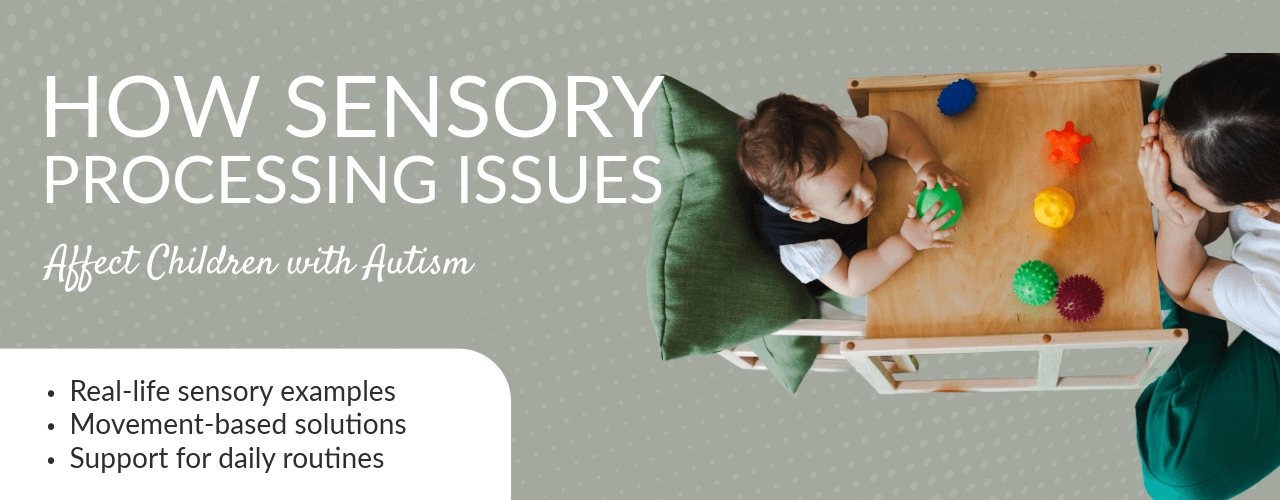
Does your child seem overwhelmed by bright lights, loud noises, or certain textures? Do they avoid certain activities or have meltdowns during daily routines? You’re not alone. Many families navigating sensor processing challenges face similar struggles. That’s why understanding the connection between autism and sensory processing is key to supporting your child’s development.
Another way to support your child’s development is through pediatric physical therapy at Therapy In Motion. Our team focuses on helping children with autism build the skills they need to better engage with their world, including managing sensory processing challenges.
Read on to learn how sensory issues show up and how they affect kids with autism in daily life.
Sensory Processing and Autism: What’s the Connection?
Sensory processing refers to how the brain interprets information from the senses: sight, sound, touch, smell, taste, movement, and body awareness.
This process often works differently in children with autism. Some may be hypersensitive (over-responsive) to sensory input, while others may be hyposensitive (under-responsive). These sensitivities can manifest in different ways, including:
- A tag in a shirt that feels unbearable
- A loud hallway that causes panic
- A child who doesn’t notice when they bump into thingsx
Autism and sensory processing challenges can lead to motor delays, avoidance of physical play, and difficulty navigating everyday environments.
That’s where pediatric physical therapy comes in. One of our trained therapists can help children build motor coordination, balance, and confidence while supporting sensory integration in a safe, structured setting.
It’s Not Just a Quirk: Understanding the Physical Side of Sensory Struggles
1. Balance and Coordination Difficulties
Many children with autism have trouble with balance. They may trip often or struggle on stairs. This is often linked to the vestibular system, which controls movement and spatial awareness. Physical therapy can gently target these systems to help improve coordination and reduce falls.
2. Avoidance of Movement Activities
Children who are sensitive to motion may avoid climbing, swinging, or running. They might appear fearful or hesitant during active play. Our therapists can gradually build tolerance and confidence in movement through personalized, child-friendly strategies.
3. Low Muscle Tone or “Floppy” Movement
Some children with autism and sensory processing issues have decreased muscle tone, which can make tasks like sitting upright, walking long distances, or holding a pencil feel exhausting. Our physical therapists help support core strength and endurance at a pace that suits your child.
4. Unusual Walking Patterns
Toe-walking, wide-based walking, or poor posture can be signs of sensory input challenges, as they can relate to how the child perceives pressure or body position. Physical therapy helps encourage healthier movement patterns to protect joints and build stability.
5. Difficulty with Everyday Routines
Getting dressed, brushing teeth, or transitioning between activities can feel physically uncomfortable for kids with autism, and the sensory overload may lead to frustration or shutdowns. We can introduce calming movement strategies that support smoother routines.
6. Craving Intense Sensory Input
Hyposensitive children seem to seek pressure, jumping, or spinning as a way to help them feel more regulated. We can offer safe, structured ways to meet these sensory needs while promoting healthy movement.
A Physical Approach to Autism and Sensory Processing
Our pediatric physical therapists do more than just improve movement. They understand how autism and sensory processing issues intersect and can provide targeted support to help your child:
- Gain strength and coordination
- Improve body awareness
- Feel more comfortable in their environment
- Engage more confidently in daily life
Your Child Deserves Support That Works
At Therapy In Motion, our pediatric physical therapy team tailors each session to meet your child where they are. If your child is struggling with sensory processing challenges related to autism, we’re here to help.
Contact our Olathe, KS clinic today to schedule an evaluation and get expert support for your child’s development.



Leave a Reply